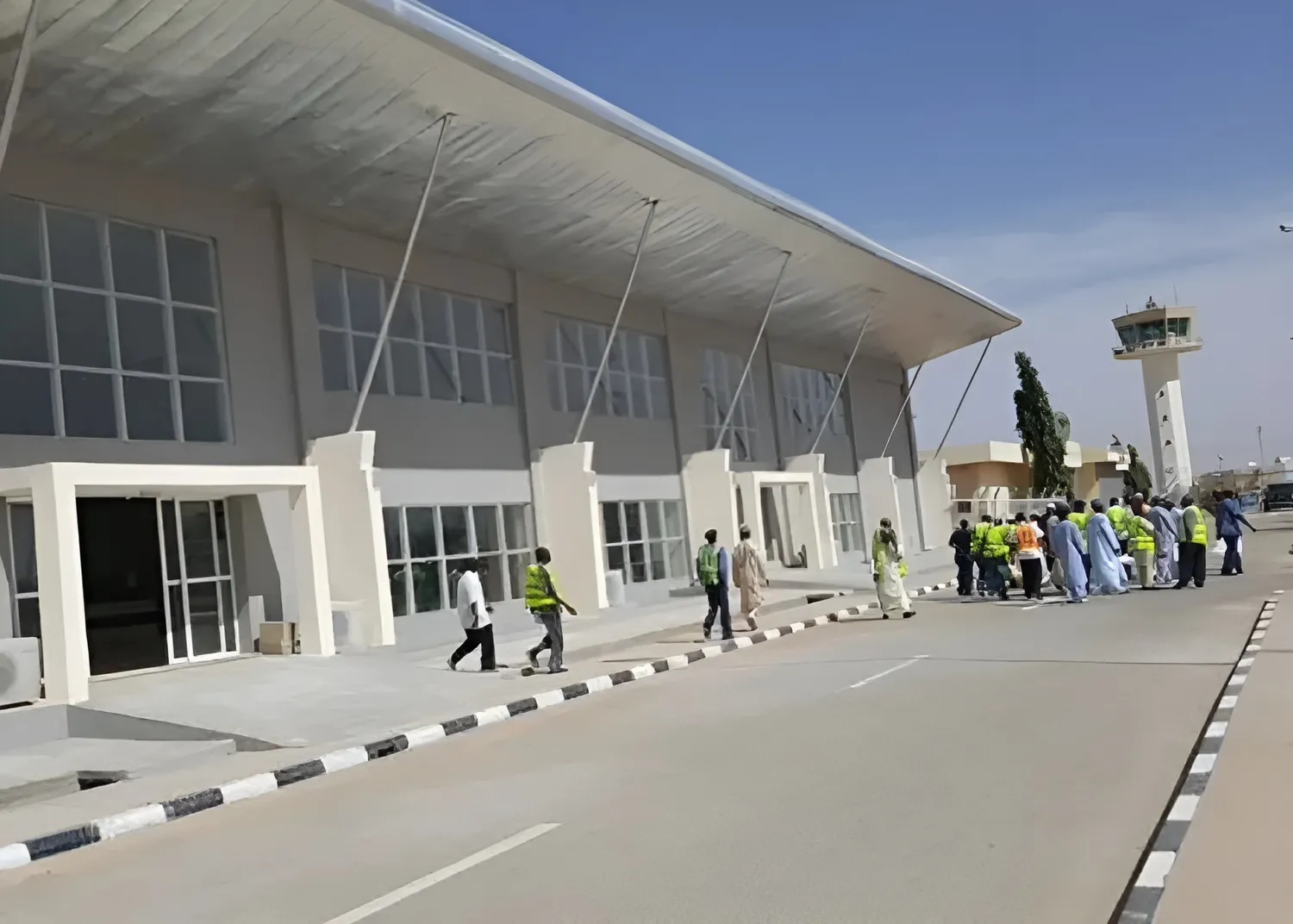
The atmosphere inside the international arrivals terminal at the Umaru Musa Yar’Adua International Airport in Katsina was one of celebration. Families stood behind security barriers waiting to embrace relatives returning from Saudi Arabia after completing the 2026 Hajj pilgrimage. Airport officials moved methodically through familiar administrative routines, and returning pilgrims wheeled their luggage toward the main arrival hall after presenting their travel documents for standard border clearance.
As passengers stepped forward one after another for immigration clearance, border control officers quietly isolated seven men from the rest of the arriving passengers. There was no public commotion, no shouting, and no dramatic confrontation inside the terminal. The men were discreetly separated from the other pilgrims, escorted out of public view under heavy security detail, and placed in immediate custody.
Within hours, the seven detainees were moved out of the airport under armed escort and subsequently flown to Abuja, where they were handed over to the State Security Service (SSS).
Days later, the Minister of Interior, Olubunmi Tunji-Ojo, made a public announcement that transformed the quiet airport operation into a subject of intense national debate. The minister stated that security agencies had intercepted seven suspected commanders of Boko Haram and ISWAP who had returned from the Hajj through the Katsina airport.
Nigeria faces several types of terrorism from groups like ISWAP, Boko Haram, and bandits. Several groups of bandits operate in Katsina, where thousands of people have been killed or kidnapped in recent years.
The government presented the arrests as evidence of Nigeria’s expanding digital border management capabilities, highlighting technical advancements in biometric identity verification and real-time intelligence coordination among security agencies.
As of the time of publishing this story, neither the federal government nor the SSS has publicly released the identities of the seven suspects or announced any criminal charges against them.
While the minister’s announcement generated major headlines across the country, it also left behind a series of fundamental questions. The most critical question raised by the operation is not how the men were apprehended upon their return, but how they managed to leave Nigeria in the first place.
Unlike some transnational criminals who utilise forged travel documents, stolen identities, or clandestine border crossings, immigration officials familiar with the operation confirmed to PREMIUM TIMES that the seven suspects travelled using valid Nigerian international passports issued in their own legal names and identities.
The seven men completed all official Hajj travel procedures before leaving Nigeria. This paradox raises difficult accountability questions extending far beyond the immediate fate of the seven suspects: What specific security screening protocols exist before an intending pilgrim is cleared to leave Nigeria? Which institutions bear the statutory responsibility for identifying registration applicants who are already on national security watchlists? Did the intelligence identifying these suspects emerge only while they were overseas, or were crucial opportunities to intercept them missed before they boarded their outbound flight? Most fundamentally, where does administrative accountability reside among the overlapping state and federal institutions that coordinate one of Nigeria’s largest annual international migrations?
Over several days of field reporting, PREMIUM TIMES interviewed security personnel familiar with the airport operation, spoke with anonymous policy and intelligence sources, questioned civil society leaders, and visited the headquarters of the Katsina State Pilgrims Welfare Board. PREMIUM TIMES also reviewed official government statements, examined the administrative mechanics of the annual Hajj workflow, and sought clarifications from every primary institution involved.
What emerged was a fragmented institutional picture. Federal authorities describe the operation as a successful intelligence-led border interdiction enabled by integrated digital systems, while civil society groups argue it exposed weaknesses in pre-departure vetting. Several of the institutions responsible for processing intending pilgrims either declined to explain their screening procedures or failed to answer key questions.
Rather than determining the guilt or innocence of the suspects, this investigation examines how those institutional responsibilities intersect and where accountability for pre-departure screening ultimately lies.
How the Hajj Vetting and Registration System Works
To evaluate how the seven suspects departed the country, it is first necessary to reconstruct the structured administrative process that an ordinary citizen must follow to perform the annual pilgrimage under Nigeria’s official framework.
Travelling for Hajj is not a simple commercial transaction; for the vast majority of Nigerian Muslims, it is a months-long, highly regulated bureaucratic process involving shared responsibilities among state governments, federal agencies, and Saudi Arabian authorities.