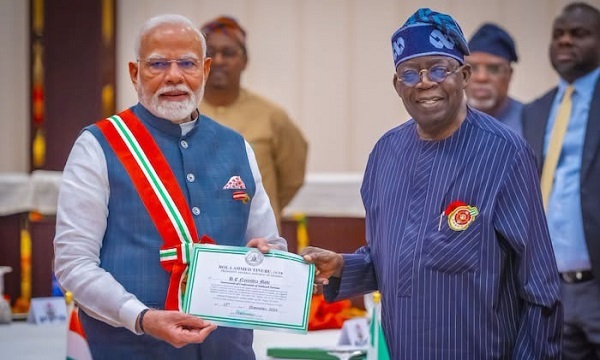
Indian Prime Minister Narendra Modi has invited President Bola Ahmed Tinubu to the BRICS Leaders’ Summit, The Nation learnt.
The summit is scheduled for September 12–13, 2026, in New Delhi.
The Indian High Commissioner to Nigeria, Abhishek Singh, made the disclosure in Abuja.
He said India is seeking stronger Nigerian participation in global economic and political platforms, particularly BRICS.
Singh said Nigeria’s participation was important because of its position as Africa’s largest economy and one of the world’s most populous nations.
He therefore expressed hope that the Nigerian President would lead a high-powered delegation to the summit.
He said, “In 2026, India has, you know, conveyed that we will discuss pressing global challenges, economic cooperation, and outreach sessions.
“President of Nigeria, President Bola Ahmed Tinubu, GCFR, has been invited to the BRICS Summit, which is going to take place in New Delhi in a few weeks from now, and we are very hopeful that the Honourable President of Nigeria will be leading a high-powered delegation for the BRICS Summit very soon.
“Why do we feel that Nigeria’s participation as a BRICS partner country is important? Because as Africa’s largest economy and one of the most populous nations in the world now, Nigeria as a partner country brings immense strategic importance.”
India assumed the BRICS chairmanship in 2026, with the summit expected to focus on pressing global challenges, economic cooperation and outreach to partner countries.
He noted that the two countries are also backing each other’s aspirations at the United Nations.
Singh disclosed that Nigeria has conveyed its support for India’s campaign for a non-permanent seat on the UN Security Council, while India has also conveyed its support for Nigeria’s candidacy.
India’s campaign is being promoted under the banner “SHANTI” — Securing Holistic Advancement through Norms, Trust and Integrity. Related News
According to Singh, the campaign reflects India’s vision of a peaceful, inclusive and reformed global order.
He reiterated India’s position that reform of the UN Security Council should include expansion of both permanent and non-permanent membership.
Singh also highlighted the contribution of the Indian community in Nigeria, estimating that about 60,000 Indians live in the country.
Many, he said, are second- and third-generation Indians who are now deeply rooted in Nigerian society.
He expressed appreciation to the Nigerian government and people for providing the Indian community with the space and opportunities to thrive.
According to him, the community has become an important bridge between the two countries in education, healthcare, culture and commerce.
He said many members of the community regard India as their motherland while also considering Nigeria their fatherland.
India established its Liaison Office in Lagos in 1958, two years before Nigeria’s independence, laying an early foundation for the relationship between the two countries.
He recalled that the relationship between the two countries was elevated to a Strategic Partnership in October 2007, signalling a shift towards broader political, economic and security cooperation.
Nearly two decades later, Singh said the partnership had grown into a multidimensional relationship with significant implications for both countries and the wider Global South.
With bilateral trade now approaching $10 billion, more than 200 Indian companies operating in Nigeria, nearly 100,000 Nigerians employed by Indian firms, and cooperation expanding across defence, energy, healthcare, agriculture and technology, the relationship between Abuja and New Delhi appears poised for an even deeper phase.
For India, Nigeria is no longer merely a major African trading partner. It is increasingly being positioned as a strategic partner in shaping the future of Africa, the Global South and the emerging multipolar world.