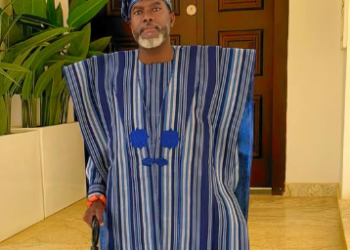
At 60, Chief Dr Chukwudi Okparaku has a story that stretches beyond business success. It is a story of humble beginnings, difficult choices, personal sacrifices, cultural identity and an enduring belief that perseverance can turn life’s setbacks into stepping stones.
From working in his father’s cosmetics business in Onitsha, Anambra, to establishing interests in freight forwarding, manufacturing, transportation, logistics and oil and gas, Okparaku’s journey has been shaped by the determination to build something of his own.
As he celebrated his 60th birthday on Sunday, Oct. 25, 2026, the businessman and traditional leader looked back on more than four decades of enterprise, recalling the disappointments that tested him, the relationships that opened doors and the values that helped him remain focused on his goals.
“From 1988 till today, I have been on the block. It has not been easy, but being patient, consistent, hardworking and committed to my vision has brought me to where I am today,” he said in an interview.
For Okparaku, success did not arrive overnight. It emerged from years of persistence, learning from mistakes and making difficult decisions when circumstances offered few easy options.
The courage to start again
Okparaku’s entrepreneurial journey began in 1986, after he left school in 1985 and joined his father’s cosmetics trading business in Onitsha.
He worked alongside his father for about two years before disagreements compelled him to leave in 1988 and begin fending for himself.
Leaving a familiar business environment to pursue an independent path meant accepting uncertainty. But the experience became a defining moment in his life, forcing him to take responsibility for his future and develop the resilience that would later become central to his business philosophy.
He said the values instilled in him by his parents, particularly honesty and truthfulness, continued to guide his professional decisions.
“My parents taught me to be honest and truthful in whatever I do,” he said.
He believes that business success depends not only on securing contracts but also on building a reputation that encourages customers to return.
According to him, he treats every assignment with seriousness because the quality of each job contributes to the reputation of his business.
His approach, he said, has helped him retain clients and attract new ones through recommendations.
Over the years, his business interests have grown beyond freight forwarding to include manufacturing, particularly soap, cosmetics and tissue paper production, alongside investments in the oil and gas sector.
The expansion reflects his desire to diversify his investments and participate in Nigeria’s productive economy despite the difficulties of operating businesses in the country.
Navigating a difficult business terrain
For entrepreneurs operating in Nigeria’s maritime and logistics sectors, success often comes with considerable challenges.
Okparaku said his career exposed him to harsh working conditions, disappointing business experiences and frustrations involving regulatory and security agencies at the ports.
Such difficulties, he explained, demanded patience, adaptability and the ability to remain focused even when circumstances threatened business plans.
Rather than allow setbacks to define his journey, he learnt to treat them as part of the experience required to build a sustainable enterprise.
His years in business also taught him the importance of relationships and the willingness of others to recognise potential before success becomes obvious.
He singled out a Pakistani business associate, Adnan, as one of the people who helped open doors for him by referring clients and facilitating opportunities involving United States companies that shipped containers for him to clear.
He also expressed appreciation to companies that had maintained business relationships with his group for more than two decades.
Although he declined to disclose the names of some companies for security reasons, he acknowledged their longstanding support.
Reflecting on those who opposed him during difficult periods, Okparaku said he learnt to transform criticism into motivation.
“Those who threw stones at us, we gathered the stones to build mansions,” he said.
The statement captures a central lesson from his experience: adversity does not necessarily have to determine the outcome of a person’s life.
A heritage rooted in tradition
Beyond business, Okparaku’s identity is closely connected to his Igbo heritage and the traditional institutions through which communities preserve their history and values.
Born in 1966, he said his father took him to their ancestral community in 1975 because he wanted him to understand his origins, cultural responsibilities and the traditions that had shaped previous generations.
His father believed that growing up solely in Onitsha would not provide sufficient exposure to the customs and values of their ancestral home.
Okparaku subsequently learnt from elderly relatives, some of whom were about 90 and 100 years old.
Their teachings, he said, gave him a deeper understanding of his people’s customs, succession practices and cultural identity.
“My father believed strongly in culture, tradition and succession. He wanted me to understand our customs and know where I came from,” he recalled.
His cultural commitment is reflected in the traditional titles he holds, including Eze Chukwukwadoro Ndi-Igbo, Bobaselu of Ikotunland and Eze Ndi-Igbo of Ikotun/Igando.
For him, traditional leadership carries responsibilities that extend beyond the prestige associated with a title. It also demands an understanding of community history, the preservation of cultural values and a willingness to contribute to the welfare of the people.
His Christian upbringing has also played an important role in shaping his outlook.
Okparaku said he was baptised in the Catholic Church a month after his birth and later spent several years with the first Catholic priest in his area after the death of some of the elders who had raised him.
He described his involvement in the Church as a commitment to service rather than mere attendance.
The combination of cultural identity and religious conviction, he said, has influenced his approach to family, business and community responsibilities.
When the community needed him
Perhaps one of the most consequential chapters of Okparaku’s life has been his involvement in efforts to restore peace to his ancestral community after armed groups overran the area and forced residents to flee.
For him, the crisis was not simply a security problem affecting a distant location. It was a personal tragedy involving people, homes and a community to which he remained deeply connected.
He said watching residents abandon their ancestral homes and seek refuge elsewhere became unbearable.
“When the community was overrun by bandits, people ran away. Watching my people go into exile was something I could not swallow,” he said.
The crisis prompted him and other concerned individuals to establish Odimmaosu, an organisation through which they mobilised resources and supported efforts to restore peace.
Okparaku emerged as the organisation’s leader and worked with other community members to engage the state government, the Nigerian Army and other security agencies.
The intervention, he said, demanded courage and considerable personal sacrifice.
Some people warned the group against entering the affected area, but members remained determined to contribute to the community’s recovery.
“People warned us not to go, but we said no. If we do not go, who will do it? Some of us emptied our pockets,” he recalled.
When members of the group visited the community in 2023, the roads were overgrown with weeds and the area appeared deserted.
He said several people had been killed during the violence, leaving residents with painful memories and a difficult task of rebuilding their lives.
Okparaku credited the eventual restoration of normalcy to the combined efforts of community members and security agencies, while acknowledging the contributions of the many people who participated in the intervention.
“God used us. I was just an integral part of it. There were many gallant men and women that God used,” he said.
His account highlights a dimension of leadership that is often overlooked: the willingness to commit personal resources and accept risks when a community faces a crisis.
For Okparaku, his connection to his ancestral home made standing aside an unacceptable option.
A businessman who still believes in Nigeria
Having travelled abroad and observed conditions in other countries, Okparaku said he remains convinced that Nigeria has the potential to provide opportunities for its citizens and attract investors from around the world.
He attributed his patriotism partly to the lessons he learnt during his elementary school years, when pupils were taught to take pride in their country.
“I have been abroad and seen it all, but I understood that those countries did not belong to me. I am a Nigerian, and I carry my Nigerian passport with pride wherever I go,” he said.
Rather than abandon the country in pursuit of opportunities elsewhere, he said he returned with the determination to apply his experiences to building businesses at home.
His confidence in Nigeria, however, does not mean he is unaware of its challenges.
He identified leadership as a major factor affecting the country’s ability to realise its economic potential.
“I believe in Nigeria. Till today, I believe in Nigeria. Tomorrow, I will still believe in Nigeria,” he said.
He expressed hope for a future in which better leadership and improved economic conditions would make Nigeria an attractive destination for international businesses, workers and investors.
His continued investment in manufacturing and other sectors, he said, reflects his confidence that the country’s prospects remain promising.
For an entrepreneur who has spent decades navigating a difficult business environment, that optimism is also a statement of commitment to the country in which he has built his livelihood.
The woman behind the journey
While Okparaku’s business interests and community interventions tell part of his story, he insists that his journey cannot be fully understood without acknowledging the sacrifices of his wife.
The couple have been married for 25 years, and he described her as a major source of strength during the difficult early years of their marriage.
Their life together was not always comfortable. He recalled periods when they struggled to afford transportation and basic necessities, sometimes trekking from Ilasa-Maja to Ikotun because they could not pay the fare.
He also remembered returning from business trips to Tincan Island late at night, sometimes finding his wife awake and waiting for him.
Only recently, he said, did he learn the extent of her sacrifices, including occasions when she visited her sister to obtain food because the family could not adequately meet its needs.
The discovery deepened his appreciation of the role she played during their difficult years.
“My wife is a jewel of inestimable value. She is a wife given to me by God because He knew that I needed someone with patience and endurance by my side,” he said.
He renamed her Ezinne, meaning a good woman, in recognition of her character and contribution to their family.
“She laboured with me. She stayed through thick and thin, in prayer. Every battle fought in this house has been fought with our nails,” he said.
His tribute offers a reminder that the visible achievements of a businessperson may rest on sacrifices made privately by family members who share the uncertainty of the journey.
For Okparaku, his wife’s contribution is not an afterthought to his success story. It is an integral part of it.
Sixty years of lessons and gratitude
At 60, Okparaku describes his life as a journey marked by difficult experiences, mistakes, unexpected opportunities and lessons that strengthened his character.
Rather than dwell on past errors, he said he prefers to regard them as experiences that helped prepare him for later responsibilities.
“Whatever happened in the past is a lesson that helped to nurture the person I am today. In Igbo land, we say you do not go backwards; you move forward,” he said.
His reflections suggest that reaching 60 has brought a shift in emphasis from personal achievement towards the value of experience and the responsibility to pass knowledge to younger generations.
He said he hoped to live long enough to mentor young Nigerians, help them make informed decisions and contribute to building the economy.
“I want to impact and impart the wisdom I have to this generation, help direct them and contribute to building the economy,” he said.
For him, the next chapter should not be measured solely by the expansion of his businesses or the titles he holds, but also by the lives he can influence and the contributions he can make to society.
He expressed gratitude for surviving the uncertainties he encountered throughout his life, describing himself as someone who had faced difficult circumstances and emerged with greater understanding.
“I can describe myself as a man who came, who saw and who conquered,” he said.
The journey continues
Okparaku’s 60th birthday marks a milestone in a journey that began with a young man leaving his father’s business to establish his own path.
The years since have brought business expansion, traditional responsibilities, community service and the experience of building a family through periods of financial uncertainty.
His story also reflects the realities of entrepreneurship in Nigeria, where ambition often has to contend with infrastructure challenges, regulatory difficulties and economic pressures.
Yet, he remains committed to investing in the country and contributing to its future.
As he looks ahead, his priorities include serving his community, supporting younger people, strengthening his businesses and helping to build a country in which future generations can thrive.
His message to young Nigerians is rooted in the lessons he says life has taught him: remain honest, work diligently, persevere through difficult circumstances and do not allow past disappointments to determine the future.
At 60, Okparaku’s greatest ambition appears to extend beyond celebrating how far he has come. He wants to use the experience gathered along the way to help others find their own paths.
And, as he puts it, his hope is to live long enough to witness a Nigeria that fulfils its enormous promise.