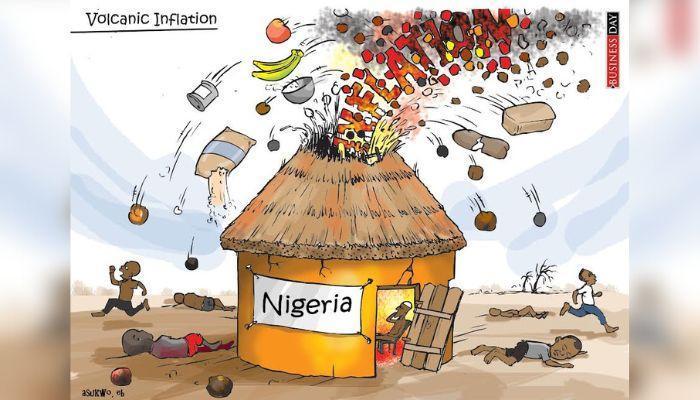
The twin economic problems of inflation and exchange rate deterioration have become persistent in Nigeria. They have become monsters that have defied various policy solutions. Without putting these two rates under control, the desire for economic growth would continue to be elusive. Our focus here is on inflation.
To proffer solutions to a problem, it is a standard requirement that the nature or background of the problem be understood. To enable us to achieve this, we will attempt to provide some economics behind this persistent rise in prices. This should hopefully provide the perspective for our suggested solutions.
Policymakers’ current approach to policy rate adjustments to combat inflation is complicating the situation and making the inflationary problem more persistent. This approach may stem from the wrong diagnosis of the problem, as it leads to increased deposit and lending rates without compensating for the desired reduction in the inflation rate.
The current structure of the Nigerian economy, the stage of development of its financial sector, and the liquidity preference behaviour of economic agents in the country do not even fulfil the necessary conditions for the use of orthodox policy tools such as policy rate adjustment as a tool to successfully and fully combat an upward inflationary trend.
The current inflation in Nigeria is more ‘supply-driven’ than ‘demand-driven’. Policy rate adjustments as a tool become ineffective when an inflationary trend is dominantly supply-driven. We tend to often argue that our inflation is caused by excess money supply in the system chasing too few goods. However, our core problem is that it is the aggregate supply level that has significantly fallen short of aggregate demand in an economy that is operating below full employment.
To simplify our exposition, we will use the familiar National Income (GDP) equation which is generally taught in the 2nd year intermediate macroeconomics class in all our universities. We would denote aggregate output (GDP) with Y and its components as: Consumption (C), Investment (I), Government expenditure (G), Export (X) and Import (M) and Net Export as X-M and write the simple GDP equation as Y = C + I + G + (X – M).
Consumption in Nigeria is primarily influenced by income, with the low level of consumer credit weakening the relationship between aggregate consumption expenditure and interest rate, as evidenced by numerous empirical studies, despite the theoretical assumption that consumption is positively related to income and negatively related to interest rate.Related News
In credit-driven societies, such as developed countries, increasing interest rates can reduce aggregate consumption and aggregate demand when there’s a disequilibrium resulting in rising prices. This works because the economy is near full employment and domestic capacity for production is high.
Investment expenditure (I) refers to the addition of capital stock or demand for investment goods used for production. It is a function of income and interest rate, with a positive relationship to income and an inverse relationship to interest rate. Increasing interest rates can reduce growth in investment demand, similar to consumption.
In Nigeria, the conventional approach to combating inflation is not optimal due to the lack of fully valid relationships between interest rate, consumption, and investment. This is particularly true for consumption, which is not fully accounted for in the policy rate increases to reduce aggregate demand.
High unemployment and declining manufacturing companies indicate a downward spiral in domestic production capacity, indicating the economy is operating below full employment. Increasing interest rates is not the right policy tool to combat inflation, as it increases borrowing rates from banks, increases the internal hurdle rate for investment decisions, reduces investment expenditure, and further decreases aggregate supply.
Nigeria’s consumption expenditure levels remain sticky with an increase in policy rate due to the relationship between consumption and interest rate. Imports of foreign goods fill the gap, causing pressure on the exchange rate. This high expenditure pressures the exchange rate, causing inflation to persist and worsen.
By inference, therefore, if we are going to make headway in our economic management in general and inflation in particular, it is essential to first accept the fact that our persistent increase in prices is a supply-driven problem rather than a demand-driven one and that the frontal solution we are implementing is counterproductive.