
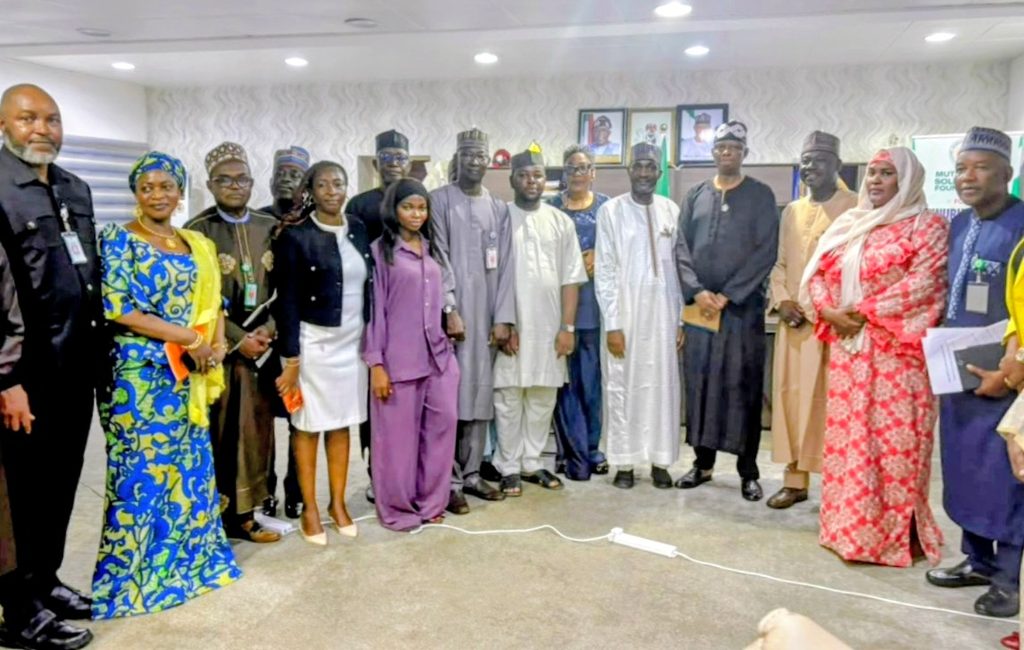
The Minister of Housing and Urban Development, Engr. Muttaqha Rabe Darma, PhD, has pledged up to ₦10 million to support the Abuja Interior and Furniture Summit 2026, with the intervention targeted by equipping young Nigerians with practical skills across furniture production, interior decoration and the broader building industry value chain.
The Minister made the commitment during a courtesy visit by the organisers and partners of the summit on Wednesday in Abuja, where he also officially unveiled the logo for the 2026 edition.
The summit is being convened in partnership with the National Board for Technical Education (NBTE), Nigerian Institute of Architects, Federal University of Transportation, Daura, TETFund, Federal University of Technology, Minna, Katsina State Government, Katsina Talent and Digital Innovation Centre, and Katsina State Institute of Management Studies.
₦10m Support Tied to Youth Empowerment
Darma said his support for the summit would be focused strictly on empowering young people and helping them acquire productive skills that could translate into employment, self-employment and enterprise development.
He noted that the Ministry might not have a direct budgetary allocation for the event, the Minister said he would personally mobilise support of up to ₦10 million, provided the organisers clearly demonstrated how the intervention would improve the productive capacity of young Nigerians.
“The money I’m going to give is going to be channelled to the young people,” he said.
“We are not doing it as individuals. What you are doing through the summit must enhance the ability of young people, and then we will put our money there.
“I promise you, we can do up to about ₦10 million, but it must be channelled towards helping young people.”
Furniture Industry Offers Jobs Across Value Chain
The Minister said the furniture and interior industry had enormous potential to create jobs across Nigeria’s housing and construction value chain.
According to him, the sector could provide opportunities for architects, designers, carpenters, furniture makers, transporters, installers, decorators, innovators and other professionals.
He said young people should begin to recognise opportunities not only in technical trades but also in creativity, design thinking and other specialised areas.
“As far as I’m concerned, there is what we call design thinking,” he said.
“You start thinking of how designs will come. You may not be the person to put pen to paper, but you can tell someone who has the skill of putting pen to paper what you are thinking, and that person will translate your thoughts into something tangible.”
He said the summit could help young Nigerians discover hidden talents and convert them into productive skills and sustainable livelihoods.
“This summit will eventually help a lot of young people realise the value that is inherent in that aspect of the value chain of the building industry, furniture making and decoration in the house,” he said.
“At the end of the day, so many people will have work. So many people will know what to do. So many people will have skills and know the value that is inherent in them, which they may not even know now.”
Nigeria Seeks to Cut Dependence on Imported Furniture
The organisers said the summit was conceived to address Nigeria’s heavy dependence on imported furniture, promote locally made products, strengthen technical and vocational skills, create jobs and improve standards in furnishing and interior design.
Speaking during the visit, Coordinator of the Abuja Interior and Furniture Expo, Faisal Jafar Rafindadi, said the initiative had evolved from years of promoting innovation and local furniture production, including activities linked to the Katsina Furniture and Innovation Centre.
He said Nigeria’s furniture industry had enormous economic potential but continued to face major constraints, including inadequate machinery, unstable power supply and weak infrastructure.
According to him, estimates by furniture makers showed that Nigeria spent more than $8 billion annually on furniture imports in 2019, highlighting the need to strengthen domestic manufacturing and reduce dependence on foreign products.
“Our goal is to promote made-in-Nigeria furniture, create jobs for youth and ensure that homes built under the leadership of the Ministry are world-class in design and furnishing,” Rafindadi said.
Architects Raise Concern Over Shortage of Skilled Artisans
President of the Nigerian Institute of Architects, Architect Sani I. Saulawa, said Nigeria must urgently address the shortage of properly trained artisans and middle-level technical professionals in the construction industry.
He warned that the growing skills gap in carpentry and other building trades was contributing to poor workmanship and projects that failed to meet approved standards and specifications.
“You find out that there is a lot of shoddy work or work that is not done to standards and specifications, which often leads to failures and eventually collapse,” he said.
“We want to partner with organisations like this with the view that we can provide the necessary skill acquisition and training in those various fields.”
Saulawa said the Nigerian Institute of Architects was supporting the summit because of its potential to improve technical competence, raise standards in the built environment and create sustainable employment opportunities.
NBTE Moves to Formalise Informal Skills Sector
Abdulhamid Usman, Personal Assistant to the Executive Secretary of the NBTE, said the Board was working to formalise Nigeria’s vast informal sector, particularly in furniture production and interior decoration.
He said many Nigerians possessed practical skills but lacked structured training, certification and opportunities to further develop their crafts.
Usman expressed optimism that the partnership would create awareness among young Nigerians and support government efforts to expand skills acquisition, entrepreneurship and technical education.
KSITM Expands Multi-Skills Training
Also speaking, the Rector of the Katsina State Institute of Technology and Management, Dr Musa Ahmed Zayyad, said the institution had expanded its training programmes to ensure that students graduated with academic, entrepreneurial and practical competencies.
He said the institute now offered close to 18 skills-based programmes, including carpentry, welding, fashion and soft skills such as public communication and effective writing.
According to him, the institution recently acquired skills-development equipment worth more than ₦54 million through TETFund support and was working to expand its training capacity.
Zayyad said the Minister, who serves as Chairman of the institution’s Governing Council, had directed that students should graduate with multiple competencies.
“Our students, when they graduate, must graduate with three skills or certificates,” he said.
“First is the certificate for the programme they were admitted to study. Then they must acquire entrepreneurship skills, divided into technical skills, those you learn with your hands, and soft skills, those you use with your brain and mind.”
Summit to Open New Chapter for Industry
The Minister commended the organisers for their creativity and determination, urging them to remain resilient despite the challenges of building a sustainable local industry.
“I like what Faisal is doing. I like his creativity and innovative mind, trying to bring things that will move young people, challenge them, make them think and make them use their own brains,” Darma said.
“You will see ups and downs. You are going on a bumpy road. There must be challenges. Try as much as you can to surmount those challenges.”
Dr. Kabiru Mustapha, medical doctor who joined the delegation, also highlighted the importance of occupational health and safety for artisans and workers in furniture production, construction and related trades.
The Minister subsequently unveiled the logo for the Abuja Interior and Furniture Summit 2026, describing the initiative as a new chapter for Nigeria’s furniture and interior industry.
The organisers said the summit would bring together stakeholders from education, technical training, architecture, furniture production, innovation, technology and the housing sector to explore strategies for building a stronger local industry.
They said the initiative would prioritise artisan development, made-in-Nigeria furniture, innovation and pathways for young Nigerians to transform practical and creative skills into sustainable livelihoods.
“This is the beginning of a new chapter for the Nigerian interior and furniture industry,” the organisers said.
“Together, we will build, design and furnish the Nigeria of our dreams.”