In Nigeria’s long and complicated struggle with insecurity, one issue has remained stubbornly consistent: the gap between policy ambition and operational reality. No Tuesday in Abuja, that gap came sharply into focus as lawmakers, security experts, and civil society actors gathered to rethink one of the country’s most critical intervention tools in the Nigeria Police Trust Fund (NPTF).
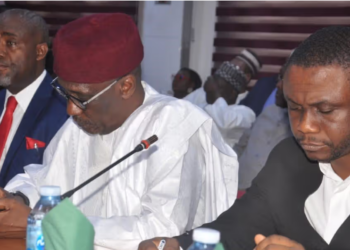
At a public hearing convened by the Senate Committee on Police Affairs, the conversation went beyond routine legislative review. It became, instead, a candid diagnosis of a system under strain, and an urgent search for solutions.
At the centre of the discussion is a new bill seeking to repeal and re-enact the NPTF Act of 2019. For many stakeholders, the proposed Nigeria Police Trust Fund (Establishment) Act, 2026 represents more than an amendment; it is an opportunity to reset the foundation of police funding in Africa’s most populous nation.
“We are dealing with realities that have outgrown the current law,” said Femi Mohammed Sheidu, the newly appointed Executive Secretary of the Fund. His message was clear: Nigeria’s security landscape has evolved faster than its funding structures.
From terrorism in the North-East to banditry in the North-West, kidnapping across major highways, and the rising sophistication of cybercrime, the demands on the Nigeria Police Force have expanded dramatically. Yet, the resources required to match these threats have not kept pace.
The proposed legislation attempts to bridge that gap. One of its most significant provisions is the planned increase in statutory funding, from 0.5 percent to 1 percent of the Federation Account. It also removes the sunset clause embedded in the current law, effectively transforming the Trust Fund from a temporary intervention into a permanent fixture in Nigeria’s security architecture.
For Sheidu, this shift is essential. Without long-term financial certainty, he argued, strategic planning remains limited, partnerships fragile, and reforms inconsistent.
But funding alone is not the only concern, as the hearing unfolded, a deeper conversation emerged, one centred on governance, accountability, and the very structure of policing in Nigeria. Stakeholders questioned who should determine the priorities of the police, how funds should be managed, and whether the system adequately reflects operational realities.
A recurring theme was the role of the Inspector-General of Police. Several contributors argued that those closest to the field should have greater influence in decision-making. Suggestions ranged from elevating the IGP’s representative to a leadership position within the Fund to transferring responsibility for needs assessment from the Ministry of Police Affairs to the police hierarchy itself.
Civil society organisations added another layer to the debate, raising concerns about transparency and inclusion. They pointed to the removal of civil society representation from the proposed board structure, a provision that existed in the 2019 Act—as a step backward for accountability.
Even more striking was the attention to detail. A controversial clause in the draft bill describing the Executive Secretary as a person of “questionable character” drew sharp criticism, highlighting the importance of precision in legislation that carries significant institutional weight.
Beyond governance, the human dimension of policing took centre stage
Lawmakers and stakeholders alike painted a sobering picture of life within the force: officers struggling with inadequate equipment, poor housing, delayed benefits, and minimal support for families of fallen colleagues. For many, the issue was not just about funding levels, but about how those funds translate into tangible improvements on the ground.
“If welfare is not addressed, reforms will remain theoretical,” one participant noted, echoing a sentiment widely shared across the room.
There were also structural concerns. The continued deployment of large numbers of police personnel to VIPs and private individuals was criticised as a misallocation of scarce resources—one that weakens frontline policing and undermines public safety.
Adding to the tension was the absence of key officials, including the Inspector-General of Police and the Minister of Police Affairs. Their non-attendance did not go unnoticed, with lawmakers interpreting it as a lapse in accountability at a time when public trust in institutions remains fragile.
Yet, despite the criticisms, there was broad consensus on one point: the bill is necessary.
Senator Ahmed Abdulhamid Mallam-Madori, Chairman of the Senate Committee on Police Affairs, the task now is to refine, not reject, the proposal. He assured stakeholders that all submissions would be carefully reviewed to produce legislation that is both practical and forward-looking.
That forward-looking element may prove crucial. As discussions around state policing continue to gain traction, questions remain about how the Trust Fund will adapt to a potentially decentralised policing system. Experts at the hearing urged lawmakers to ensure that the new law is flexible enough to accommodate future reforms.
Ultimately, the debate around the Police Trust Fund is about more than budgets and board structures. It is about redefining how Nigeria secures itself, how it equips those on the front lines, how it balances power and accountability, and how it responds to an ever-changing threat landscape.
If passed, the 2026 Act could mark a turning point. Not because it solves every problem, but because it acknowledges them—and attempts, perhaps more deliberately than before, to confront them.
For a country searching for security in uncertain times, that may be a step in the right direction.